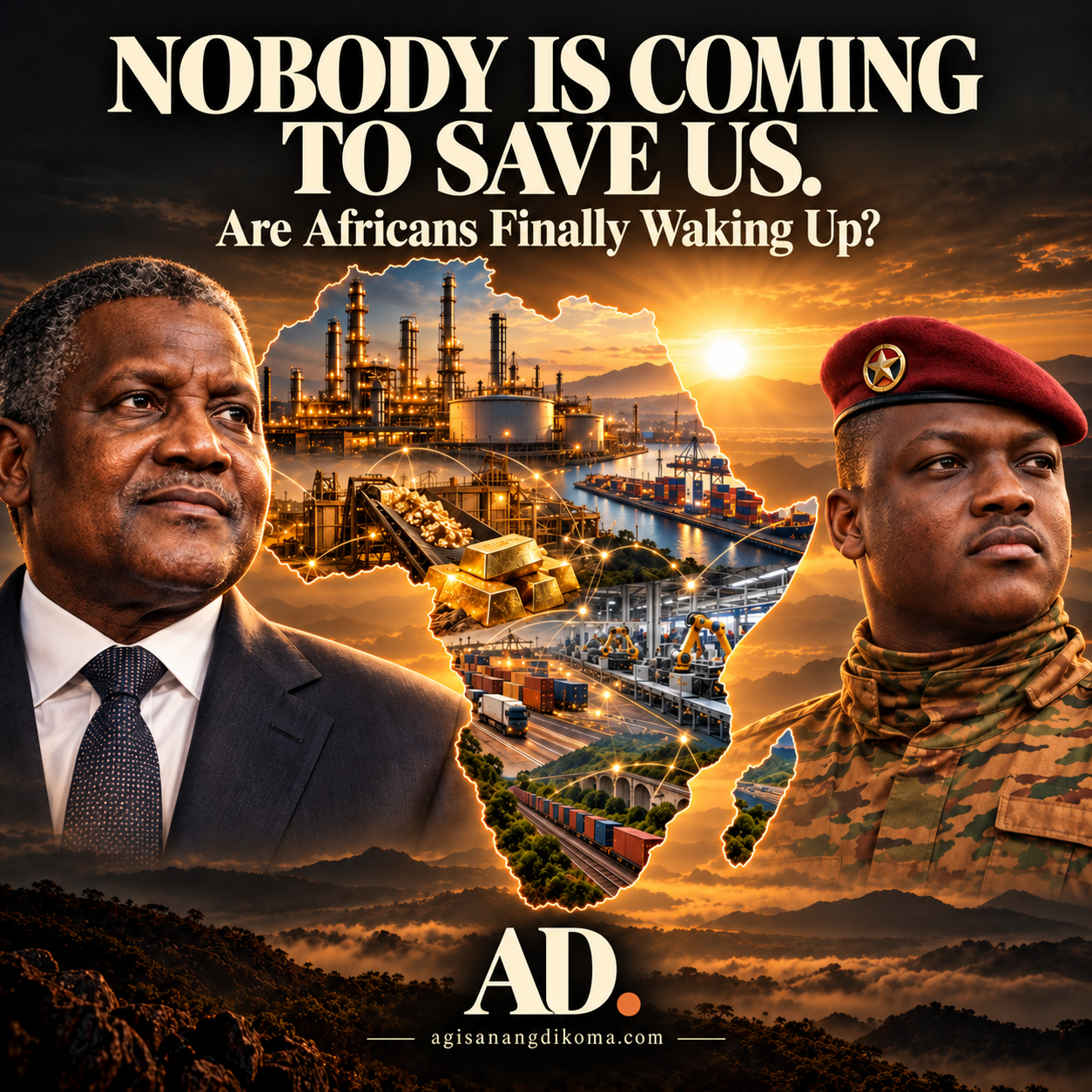
There is a phrase I have found myself thinking about increasingly:
Nobody is coming to save us.
At first, it sounds pessimistic. Almost defeatist.
But the more I watch what is happening across Africa, the more I wonder whether it might be one of the most liberating ideas we can embrace.
Because perhaps Africa does not need saving.
Perhaps Africa needs Africans who believe in it enough to build.
Over the past few years, I have watched Aliko Dangote with growing interest. Beyond the scale of his businesses, something comes through repeatedly when he speaks: his conviction about Africa.
His challenge to Africans is uncomfortable but necessary: if we are unwilling to invest in our own continent, why should we expect the rest of the world to believe in its opportunities?
His refinery in Nigeria gives that conviction physical form. It addresses one of our enduring economic contradictions: producing natural resources, exporting them, and then importing the finished products made from them.
Now that industrial ambition is extending beyond Nigeria.
On 30 September 2026, Dangote joined African leaders in Kenya for the groundbreaking of a planned $16 billion refinery in Lamu. The proposed facility is designed to process 700,000 barrels per day and supply fuel across East Africa.
What interests me most is the thinking behind it:
Africa must build.
Then I looked at Burkina Faso.
On 28 September 2026, President Ibrahim Traoré inaugurated the country’s first gold refinery, RAFFINOR-BF, with an initial theoretical refining capacity of 164 tonnes annually.
Burkina Faso already produces gold. That is not the breakthrough.
The important question is what happens after that gold is extracted.
For decades, too much of the processing and value creation associated with Africa’s resources has taken place elsewhere. Burkina Faso’s stated ambition is to retain more of that activity domestically.
Traoré and Dangote operate in very different spheres. One leads through government, the other through business. Their responsibilities and methods differ, and, like all leaders, neither should be regarded as perfect.
But perfection is not what interests me here. Direction does.
Through different approaches, both appear to be asking a similar question:
Why are Africans still exporting so much of Africa’s value?
From extraction to value creation
Much of Africa’s relationship with the global economy has followed a familiar pattern:
Extract. Export. Import.
We export crude oil and import petroleum products. We export minerals and import manufactured goods. We export agricultural commodities and import processed, branded products.
Between the raw material leaving and the finished product returning, value is created. Factories are built, skills are developed, businesses grow and capital accumulates.
Why shouldn’t more of that happen here?
A refinery alone cannot transform an economy. The real measure of this awakening will be whether these investments create lasting jobs, develop local suppliers and leave more economic value in African hands.
Still, these projects give us something concrete to examine: African governments and African businesses attempting to capture more of the value chain.
Perhaps something is changing.
For years, our development conversations have focused on attracting the world to Africa. How do we secure foreign investment, development finance and multinational participation?
Those questions remain important.
But another deserves equal prominence:
Do Africans believe Africa is investable?
Belief cannot remain in speeches. Eventually, it must become capital, infrastructure and productive capacity.
It must become an African investor financing an African business.
An African corporation choosing an African supplier.
A purchase order.
From ambition to commerce
This is where the conversation becomes particularly interesting to me.
Building industrial capacity is one part of the task. Connecting that capacity to customers across Africa is another.
If crude oil can move between African markets, why should a procurement professional in Johannesburg struggle to discover a capable Nigerian manufacturer?
Why shouldn’t a Ghanaian manufacturer be visible to a buyer in Kenya? Or a Rwandan business compete for opportunities in South Africa?
Building the factory matters. Making its products discoverable, trusted and commercially accessible matters too.
The African Continental Free Trade Area offers a framework for greater continental trade. But frameworks alone do not create commerce.
Businesses need customers. Buyers need reliable supplier information. Transactions need finance, logistics and infrastructure that work.
And procurement professionals need to recognise the role their decisions play in shaping industrial development.
Every purchase order represents a choice about where economic opportunity goes.
If we want African businesses to grow, we must make it easier to find them, assess them and buy from them.
Partnership and economic agency
Africa needs international capital, technology, expertise and access to global markets.
Welcoming those partnerships can sit alongside a firm expectation that African businesses, workers and investors participate meaningfully in the value created here.
The goal is an Africa that meets the world from a position of greater economic agency.
An Africa that can negotiate, produce, invest and trade with greater confidence in its own capabilities.
Nobody is coming to save us.
I increasingly hear responsibility in that sentence.
I hear agency.
And perhaps I am beginning to hear an awakening.
Africa has not suddenly solved its problems. These projects still have to deliver, and their value will ultimately be measured in outcomes.
But something important happens when an African industrialist commits capital to building at global scale.
Something important happens when an African country decides that extracting its resources is no longer enough.
And something important happens when Africans begin asking:
What are we going to build?
The refinery has to be built.
The factory has to be financed.
The entrepreneur has to be backed.
The African supplier has to be discovered.
The purchase order has to be issued.
The infrastructure connecting all of this has to exist.
Nobody is coming to save us.
Perhaps Africa’s next chapter begins when we believe deeply enough in this continent to build it ourselves.