For years, the conversation about electricity and South African manufacturing centred on one issue: loadshedding.
Factories lost production hours. Machinery stood idle. Delivery schedules slipped. Manufacturers invested in generators, diesel, solar installations and backup systems simply to keep operating.
The improvement in electricity availability is therefore significant. More stable supply gives manufacturers greater certainty and removes some of the disruption that defined the worst years of the energy crisis.
But it does not answer the more difficult question:
Can South African manufacturers compete when the electricity required to produce their goods continues to become more expensive?
Reliability Has Improved. Affordability Remains a Problem.
NERSA approved an average electricity tariff increase of 12.74% for Eskom’s direct customers in 2025/26, followed by a further 8.76% from April 2026. Municipal tariffs differ, meaning that the actual increase experienced by a manufacturer depends partly on where and how it purchases electricity. However, the direction is clear: electricity remains a rising input cost.
For manufacturers, electricity is not simply another overhead. It powers furnaces, production lines, refrigeration, ventilation, compressed-air systems, processing equipment and warehouses. When its price rises, the cost does not remain confined to the factory’s electricity bill.
It moves through the supply chain.
The raw-material producer pays more. The component manufacturer pays more. The packaging supplier pays more. Warehouses, distributors and retailers absorb their own increases. By the time the final product reaches the customer, several layers of energy-related cost may already be embedded in its price.
South African manufacturers must then compete against imported products produced under entirely different energy, logistics, financing and policy conditions.
Steel Shows What Is at Stake
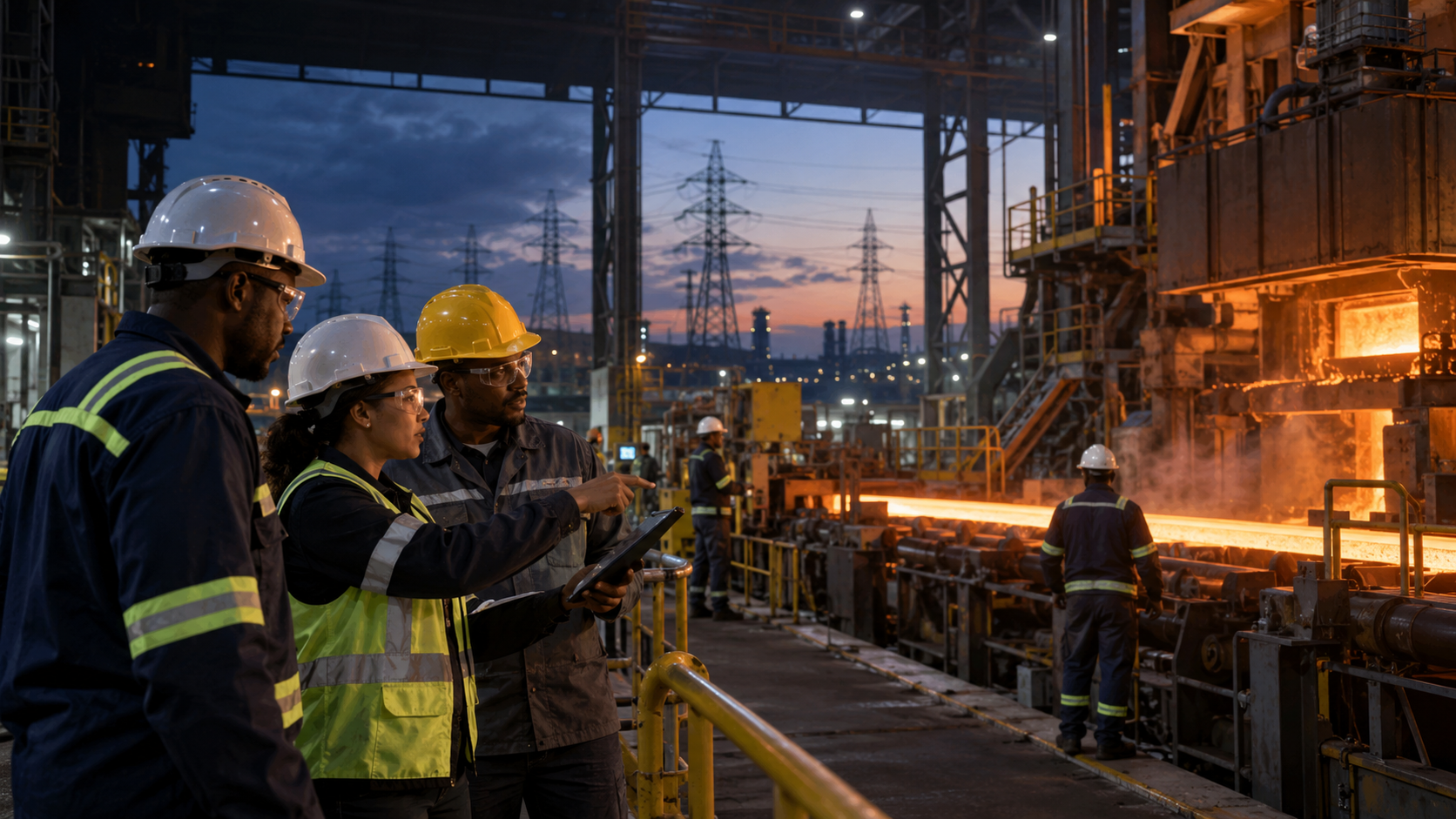
The steel industry provides one of the clearest examples because steelmaking is highly energy-intensive and sits near the beginning of multiple industrial value chains.
Steel feeds construction, mining, automotive manufacturing, rail, energy infrastructure, machinery and general fabrication. When local steel production becomes less competitive, the effect extends far beyond a single producer.
ArcelorMittal South Africa’s difficulties have highlighted the combination of pressures confronting the sector: high operating and electricity costs, weak domestic demand, inefficient logistics and competition from lower-priced imports. Its effort to secure negotiated electricity pricing also demonstrates that industrial electricity costs are no longer a peripheral concern—they can influence whether production capacity remains viable at all.
This creates a difficult policy question.
Should energy-intensive manufacturers receive more competitive electricity tariffs because of the jobs and industrial capacity they support?
The answer cannot be an unconditional subsidy. But neither can South Africa ignore the strategic value of industries that supply essential inputs to the rest of the economy.
Any industrial tariff arrangement should be transparent, conditional and linked to measurable commitments—including investment, production volumes, energy efficiency, employment and long-term competitiveness.
Manufacturing Is Already Under Pressure
The electricity-price debate is taking place against a weak manufacturing backdrop.
South African manufacturing contracted by 1.5% in the second quarter of 2026, its fourth consecutive quarterly decline. Seven of the ten manufacturing divisions recorded weaker activity. Manufacturers also used only 76.6% of their available production capacity in May, with insufficient demand identified as the most common reason for underutilisation.
These figures require careful interpretation. Rising electricity prices are not solely responsible for the sector’s performance.
Manufacturers are also contending with weak domestic demand, logistics constraints, volatile fuel and raw-material costs, ageing infrastructure, limited investment and competition from imports. In some businesses, operational inefficiency and outdated technology contribute to high production costs as well.
Nevertheless, electricity affects nearly every one of these challenges. A manufacturer operating below capacity must spread its fixed electricity and infrastructure costs across fewer units. A business investing in private generation must recover that capital expenditure. A smaller supplier that cannot finance alternative power remains more exposed than a large manufacturer with access to capital.
The result is not only higher cost. It is an increasingly uneven competitive environment.
The Hidden Cost of Keeping the Lights On
Self-generation has become an important part of South Africa’s energy response. For many businesses, investment in solar, batteries and other energy solutions has improved reliability and reduced dependence on the grid.
However, private generation is not free electricity.
It requires capital, technical expertise, maintenance, financing and suitable property. Businesses may also need to retain grid connections and pay fixed network charges because renewable generation cannot always match their production profile.
Large companies are generally better positioned to make these investments. Small and medium-sized manufacturers—many of which supply larger industrial businesses—may not be.
This matters for supply-chain resilience. A major manufacturer may secure its own electricity supply, but it remains exposed if its local packaging, component, maintenance or transport suppliers cannot do the same.
Energy resilience must be considered across the supply chain, not only at the largest factory.
Competitiveness Is a System
South Africa will not rebuild its industrial base through electricity reform alone.
A competitive manufacturer requires reliable and affordable energy, functioning ports and railways, efficient road transport, skilled labour, access to finance, consistent regulation and sufficient demand. Failure in any one of these areas raises the cost of production.
Energy is, however, one of the foundations. Without a credible long-term electricity solution, manufacturers struggle to price contracts, justify capital investment or commit to expanding local production.
The country needs a model that balances Eskom’s financial sustainability with the survival and growth of productive industry. Eskom itself has acknowledged the importance of flexible pricing in retaining industrial demand. Its 2026 integrated report identifies affordability, tariff clarity and flexible pricing for industrial customers among its stakeholder priorities.
That recognition now needs to translate into commercially workable solutions.
- More predictable multi-year electricity pricing so manufacturers can plan and contract with greater confidence
- Transparent, performance-linked tariffs for strategically important energy-intensive industries
- Faster grid access and clearer wheeling arrangements for businesses procuring electricity from independent producers
- Financing mechanisms that help smaller manufacturers invest in energy efficiency and alternative generation
- Stronger measurement of energy consumption at product and production-line level
- Industrial and procurement policies that support local manufacturing without protecting inefficient businesses indefinitely
Manufacturers must also act. Energy should no longer be treated only as a facilities-management expense. It must become part of sourcing strategy, product costing, capital allocation, supplier development and business-continuity planning.
So, Can South African Manufacturing Compete?
Yes—but not by competing on labour costs alone, and not by expecting manufacturers to absorb repeated electricity increases without consequence.
South Africa still has significant industrial capability, technical skills, established supply chains and access to African and international markets. More reliable electricity creates an opportunity to rebuild confidence in the sector.
But reliability is only the first step.
If electricity remains unaffordable, manufacturers may produce without interruption and still lose business to imported alternatives. If only the largest companies can fund energy independence, smaller local suppliers may disappear. If tariff relief is granted without accountability, the country may preserve capacity without improving competitiveness.
The real objective cannot simply be to keep factories running.
It must be to create an energy and industrial system in which South African factories can produce goods that customers—locally, across Africa and globally—can afford to buy.
That is the test of competitiveness.