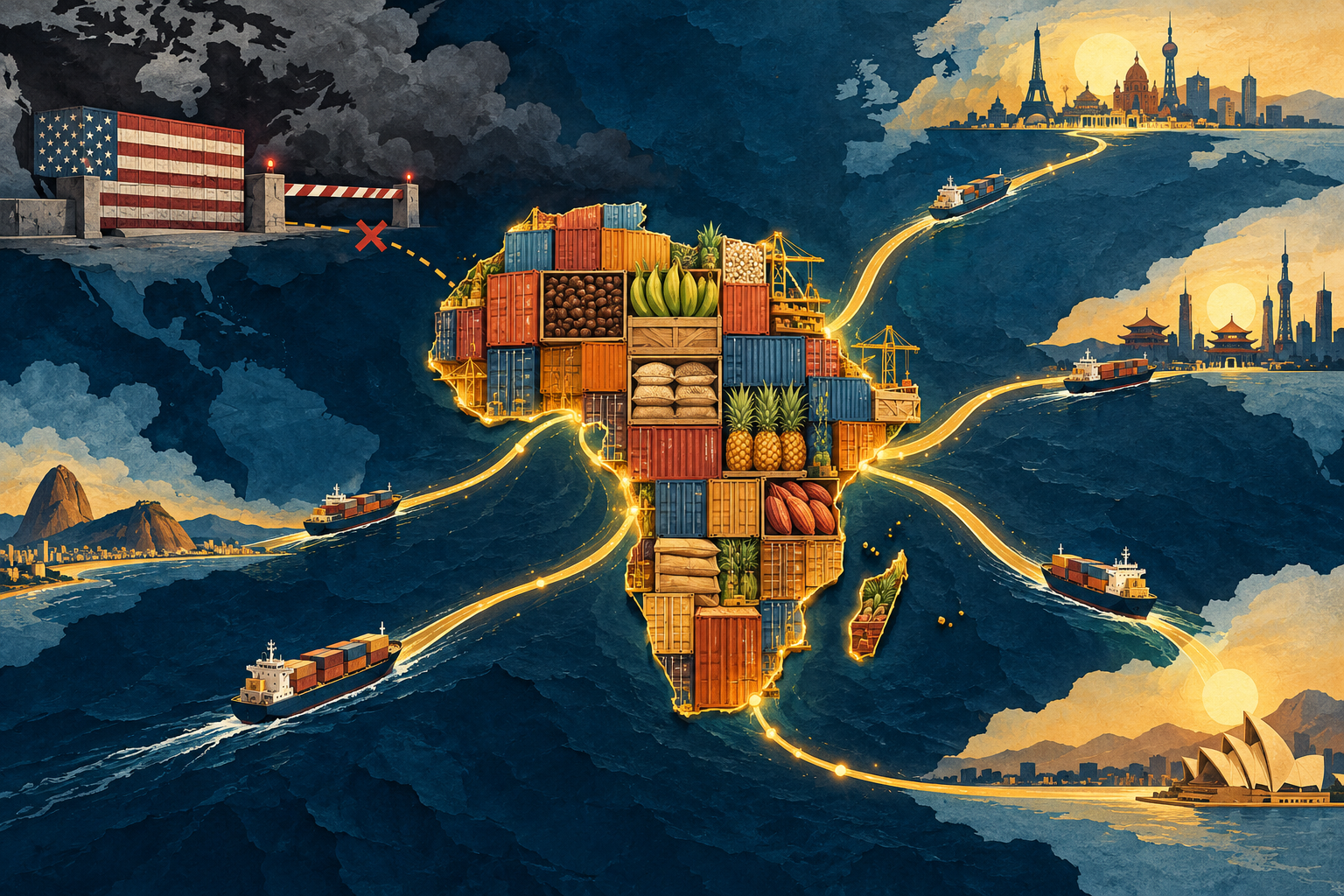
An exporter can control the quality of a product. They can negotiate a price, train workers and organise a shipment. What they cannot control is the announcement that changes the cost of entering their biggest market while those goods are already on their way.
That is where trade policy becomes personal. A tariff negotiated thousands of kilometres away reaches into a factory’s production schedule, a farmer’s next planting decision and a household’s income.
Donald Trump’s trade reversals have brought that vulnerability into sharp focus.
In July 2025, the White House shifted tariff deadlines, announced new country rates and left further changes open to negotiation. South Africa was among the countries facing a proposed 30% reciprocal rate. For businesses trying to plan ahead, the policy itself had become a moving target. [1]
A business can calculate the cost of a known tariff. Uncertainty is harder to price. An exporter must decide whether to absorb an additional cost, pass it to the buyer or risk losing the order—sometimes before knowing which rules will apply when the shipment arrives.
Investment decisions become harder still. Equipment bought today may need years of export earnings to pay for itself. A changing policy horizon makes that commitment more difficult.
The uncertainty behind the opportunity
For more than two decades, the African Growth and Opportunity Act has offered eligible sub-Saharan African countries preferential access to the American market. It has given exporters a reason to pursue US customers and investors a reason to consider African production.
But the opportunity comes with decisions made elsewhere.
Congress determines the programme’s legislative renewal, while country eligibility is reviewed annually. African businesses can meet buyers’ specifications and deliver on time while still facing uncertainty about the framework under which they trade. [2]
In February 2026, Trump signed legislation renewing AGOA through 31 December 2026, retroactively covering the period after its September 2025 expiry. His administration also made clear that it wanted greater market access for American businesses in shaping the programme’s future. [3]
Renewal brought relief. Yet a business planning a multiyear expansion still faced an authorisation period measured in months.
AGOA preferences and additional US tariffs are separate policy instruments. Securing one does not necessarily settle the other. For an exporter, the commercial question is the combined effect: can the business still serve its customer profitably, and with enough confidence to invest?
Trump did not create Africa’s dependence on external markets. His administration’s abrupt changes exposed how costly that dependence can become.
A different story in the same difficult environment
South Africa’s agricultural results offer a useful counterpoint.
In the second quarter of 2026, agricultural exports to the United States fell by 28%. Yet total agricultural exports grew by 9.1% year on year to $4.12 billion, producing a $2.14 billion trade surplus. Africa and Europe together accounted for 70.7% of agricultural exports. [4]
The figures need careful reading. Some US-bound shipments had been brought forward into the first quarter ahead of tariff changes, contributing to the subsequent decline. They do not show that every affected exporter found a replacement buyer. [4]
They do, however, show the value of having substantial business elsewhere. Weakness in one destination did not determine the performance of the entire sector.
Behind that resilience lies work that rarely commands a headline: finding customers, meeting standards, establishing distribution and learning what another market will buy.
Those relationships become especially valuable when an established destination becomes less predictable.
The next market takes time
Diversification is easy to endorse after a shock. It is harder to fund before one.
A familiar customer offers repeat orders. A new destination brings registration costs, uncertain demand and months of negotiation. For a business watching its cash flow, expanding the established relationship can seem the sensible choice.
Over time, however, that choice can leave production, employment and investment dependent on continued access to a single market.
Building alternatives requires accepting some cost today to preserve choices tomorrow. Exporters need to investigate new destinations while they still have the financial room to experiment, adapt and occasionally fail.
Governments have a corresponding responsibility. Negotiating market access matters, but businesses also need affordable transport, workable customs procedures, reliable payments and the capacity to meet product standards. An agreement becomes valuable when a company can use it repeatedly and profitably.
This gives African regional trade a central role. Neighbouring markets deserve sustained investment in customers and supply chains. Treating them as emergency destinations makes it harder to build the relationships needed when disruption arrives.
Diversification must also reach beyond geography. Selling one commodity to several countries still leaves earnings exposed to the same price cycle. Replacing one dominant overseas customer with another preserves much of the original risk.
The objective is a broader base of products, buyers and routes—and more businesses capable of using them.
Planning beyond the next announcement
African governments should continue pursuing stable US trade relations. Businesses should defend customers they have worked hard to win. Those relationships remain valuable.
Alongside that effort, they need to build alternatives with equal seriousness.
The practical test is straightforward: when a major market changes its rules, does an exporter have somewhere else to turn?
Trump’s next announcement may offer reassurance or introduce another condition. African businesses cannot choose its content or its timing.
Their strongest response begins before it arrives: a new customer, another product, a reliable regional partner—each one giving them more control over what happens next.