This week, I tried to invest in a Nigerian company.
The process should have been relatively simple. I am sitting in South Africa, the opportunity is in Nigeria, and both countries are part of a continent that has spent years talking about greater economic integration, freer movement of goods and capital, and the promise of the African Continental Free Trade Area.
I got as far as trying to move the money.
And then I couldn’t.
It was a small personal frustration, but it made me think about a much bigger problem.
Over the past few weeks, I have attended industry and procurement exhibitions in South Africa, and one thing has been difficult to miss: the presence of Chinese suppliers. They are visible, organised and actively pursuing African customers.
Initially, my instinct was to ask whether we are doing enough to protect African industry. If imported products remain cheaper even after tariffs, what chance does a local manufacturer have?
But perhaps that is only part of the question.
The more important question may be this:
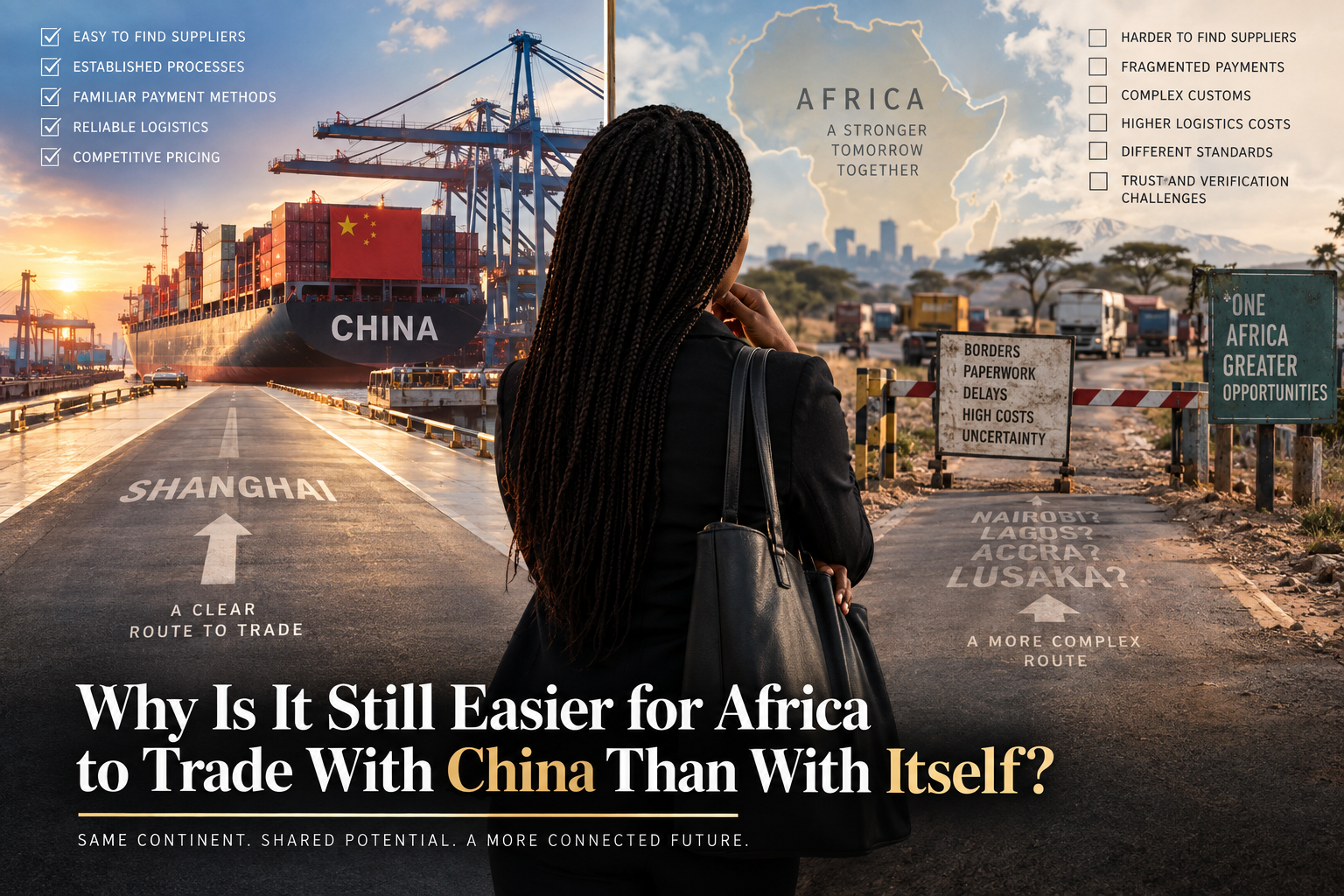
Why is it still so easy for an African company to find a supplier thousands of kilometres away in China, transact with that supplier and bring the product into Africa — while trading with another African country can feel considerably more complicated?
That changes the conversation.
China is not responsible for making intra-African trade difficult. Chinese businesses have simply become exceptionally good at participating in global trade. Their suppliers are discoverable. Their export processes are established. Payment mechanisms are familiar. Freight routes are mature. And an African procurement professional can often identify a Chinese supplier, obtain a quotation, arrange shipping and execute payment without needing to understand the intricacies of China’s domestic financial system.
Can we say the same about buying from elsewhere in Africa?
If a South African manufacturer needs a particular chemical, component or piece of equipment, how easily can its procurement team establish whether that product is manufactured competitively in Ghana, Kenya, Nigeria, Egypt, Morocco or Zambia?
And if they find the supplier, what happens next?
Can they verify the company and its manufacturing capability? Can they easily compare the total landed cost? Are the standards and certifications recognised? Can they move money between the two countries efficiently? Can they obtain trade finance and insurance? Is there a predictable logistics route? And if something goes wrong, is there a trusted mechanism for resolving the dispute?
These may sound like operational questions.
Collectively, however, they determine whether the African Continental Free Trade Area succeeds.
A Free Trade Agreement Is Not Enough
AfCFTA is one of the most ambitious economic projects undertaken on the continent. Its underlying proposition is compelling: connect African economies into a much larger market, reduce barriers to trade and allow African businesses to benefit from the scale of a continental economy.
But reducing tariffs does not automatically create trade.
A procurement manager does not purchase something simply because an agreement says it can cross a border at a preferential tariff.
Businesses make purchasing decisions based on price, quality, reliability, lead time, payment terms, logistics, risk and ease of doing business.
That means the real competitor to an African supplier is not simply another supplier.
It is the entire commercial ecosystem surrounding that supplier.
China has spent decades developing that ecosystem.
Africa now needs to build its own.
The Supplier Discovery Problem
One of the first challenges is remarkably basic: finding each other.
African countries manufacture far more than many businesses elsewhere on the continent realise. Yet there is no universally used continental procurement ecosystem through which a buyer can easily identify verified manufacturers across multiple African markets.
Imagine a South African company looking for an industrial input.
Ideally, the procurement team should be able to search by specification and immediately identify qualifying manufacturers across the continent. The results should tell them production capacity, certifications, country of origin, lead times and indicative pricing.
Instead, identifying an appropriate supplier can require knowledge of individual markets, industry associations, trade shows, personal networks and considerable research.
Compare that with the infrastructure that has developed around sourcing from Asia.
The difference matters because procurement teams are measured on delivery, cost and risk. If one sourcing route is familiar and predictable while another requires substantially more investigation, the familiar route has an enormous advantage before price negotiations have even begun.
Then You Have to Pay Each Other
My attempt to move money into Nigeria brought another part of the problem into focus.
Africa has sophisticated financial systems. It also has some extraordinary payment innovations, particularly in mobile money and instant payments.
What it does not yet have is universal, frictionless interoperability between those systems.
Historically, payments between African countries have often relied on correspondent banking relationships and international currencies such as the US dollar.
That creates an odd situation.
Two African businesses can be trading with each other, but the financial infrastructure supporting their transaction may still require them to step outside their own currencies to settle it.
The Pan-African Payment and Settlement System, PAPSS, is therefore potentially one of the most important pieces of infrastructure supporting AfCFTA.
The concept is powerful: allow an African buyer to pay in their local currency while the African seller receives payment in theirs.
A South African company buying from a Nigerian supplier should eventually be able to pay in rand while the Nigerian supplier receives naira without either company having to design the financial plumbing behind the transaction.
But infrastructure only transforms commerce when businesses can actually access it.
The goal cannot merely be to build a continental payment system.
It must be to make cross-border African payments so ordinary that businesses barely think about them.
Logistics May Be the Bigger Challenge
Even perfect payments will not solve the problem if moving the product remains prohibitively expensive.
This is where the economics of African trade become uncomfortable.
A product manufactured elsewhere on the continent can theoretically qualify for preferential treatment under AfCFTA and still lose to an Asian import once freight, port costs, border delays, inventory requirements and unreliable lead times are included.
Businesses do not procure according to geography or sentiment.
They procure according to total cost and risk.
Africa therefore needs to think beyond individual ports, railways and border posts and start thinking in terms of trade corridors.
Rather than waiting for 54 countries to become seamlessly interconnected simultaneously, we can make specific corridors work exceptionally well: harmonised customs processes, predictable border clearance, efficient road and rail connections, interoperable payments and established logistics services.
Connect successful corridors to other successful corridors and a continental trading network begins to emerge.
Trust Is Infrastructure Too
There is another obstacle that receives less attention than roads, ports and tariffs: trust.
Suppose I find a manufacturer in another African country offering exactly what my business requires.
I still need to establish whether that company exists, whether its certifications are legitimate, whether it has the capacity it claims, whether its products meet my specifications and whether it will deliver.
For established multinational suppliers, much of that information already exists within familiar commercial networks.
For an unfamiliar cross-border African supplier, obtaining the same level of assurance may be more difficult.
Africa therefore needs infrastructure for commercial trust alongside its physical infrastructure.
Verified supplier identities. Recognised certification. Credit information. Trade insurance. Escrow mechanisms. Transparent performance histories. Efficient dispute resolution.
These things sound mundane compared with announcing a new trade agreement.
But they are precisely the things that make companies comfortable issuing purchase orders.
Build an African Commercial Operating System
Perhaps we need to stop thinking about AfCFTA purely as a free trade agreement.
What Africa ultimately needs is something closer to a commercial operating system.
Imagine that I am a procurement professional sitting in Johannesburg and need 500 tonnes of a particular industrial material.
I enter the specification.
The system identifies verified manufacturers in South Africa, Zambia, Ghana, Egypt and Nigeria alongside suppliers elsewhere in the world.
But it doesn’t merely show me their factory-gate prices.
It calculates freight.
It determines applicable tariffs.
It verifies AfCFTA rules of origin.
It estimates customs charges.
It shows lead times.
It incorporates insurance.
It provides payment options.
It gives me a true landed cost and risk comparison.
If the Ghanaian manufacturer wins the tender, my company pays in rand. The supplier receives cedis. Documentation is generated digitally. Logistics are booked. The shipment is tracked. Customs documentation moves with it. Payment can be protected until contractual conditions are satisfied.
At that point, “Buy African” stops being an appeal to patriotism. It becomes a commercially rational procurement decision.
The Question We Should Be Asking
Seeing so many Chinese suppliers at African industry exhibitions initially made me wonder whether African governments were doing enough to protect local industry.
I still believe that is a legitimate question.
But I now think there is a more important one.
Have we made African businesses competitive enough with each other?
Tariffs can make an imported product more expensive.
They cannot help a procurement manager discover a manufacturer in another African country.
They cannot move a container across an inefficient border.
They cannot establish trust between two businesses.
And they cannot make fragmented payment systems interoperable.
If Africa wants to trade more with itself, we have to build the infrastructure that makes doing so easy.
Because ultimately our competition with China will not be won simply by making Chinese products harder to import.
It will be won when an African buyer can discover an African supplier, verify them, pay them, move their goods across borders and manage the associated risk as easily as they can do business with Shanghai.
That is when the promise of AfCFTA begins to become something much more important than an agreement.
It becomes the way Africa does business.