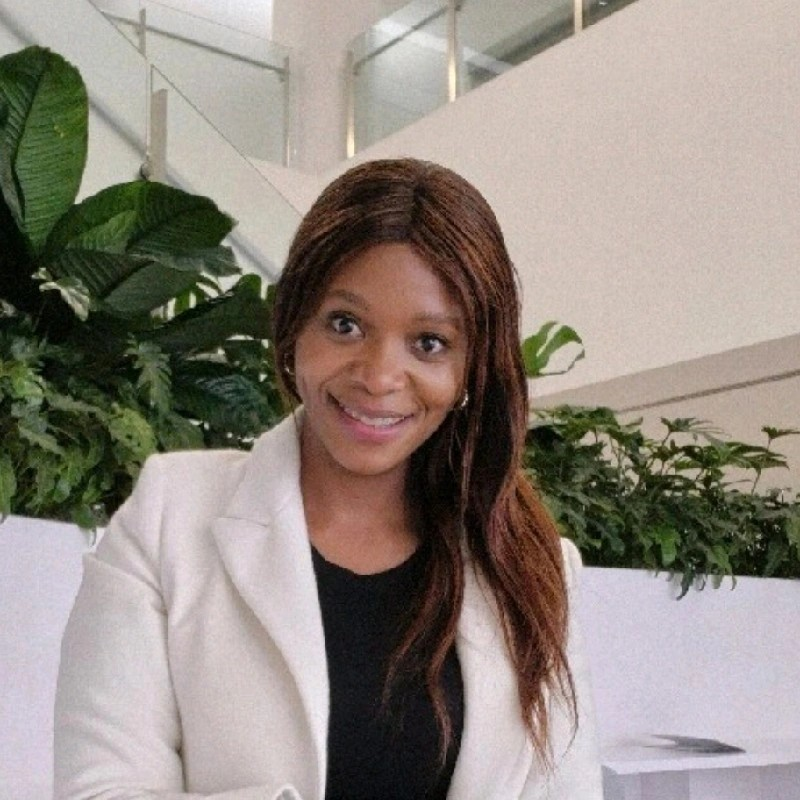
I first met Zanele when we were both starting our careers at Unilever. She was bright and ambitious, with something about her that made you feel she would go on to change the world. We were still at the beginning of our own journeys, but even then, I could see that hers would be a remarkable one. As I share her story today, I think back to the woman I met then and how much of what she has become was already there.
Before she built a career in manufacturing, supply chain and global operations, Zanele Nkomo imagined designing high-performance cars. As a teenager, she loved mathematics, physics and technical drawing, and spent time sketching the automotives she hoped one day to help create.
Her direction changed in her final year of engineering school, when consumer goods manufacturing introduced her to a different possibility: using engineering to influence products that millions of people use every day.
The setting changed, but the motivation remained. She wanted to build, solve problems and make things better. That instinct would eventually extend beyond products and processes to the people she led.
Where leadership becomes real
With a foundation in mechanical engineering and a Government Certificate of Competency (GCC), Nkomo began her career in manufacturing. She spent much of her first decade working in factories and operations across South Africa and the UK, grounding her understanding of business in people, systems, decisions and execution.
“A strategy may look brilliant on a slide, but ultimately someone has to make it work at 2 a.m. when a production line stops or when the business is under pressure.”
Her career expanded into supply chain, transformation, innovation and global operations leadership across multi-billion-dollar consumer health and FMCG portfolios. Her regional and global roles have impacted Asia Pacific, Europe, the Mediterranean, Africa, North America and Latin America. Working across countries and cultures taught her to pay attention to context rather than assume that one approach would work everywhere.
An MBA, completed cum laude, helped her understand the business beyond her function. Equally important was becoming curious about the decisions other functions faced. Technical feasibility became part of a wider conversation about consumers, growth, margin, risk and value.
She describes the shift through the questions she learned to ask: “Should we do this, what value does it create, what are we trading off, and what does it mean for the business?”
From proving to contributing
Nkomo has often been the only woman, or one of very few women, in the room. Earlier in her career, that difference made her feel she needed to adapt herself before she could contribute. With experience came a different understanding: she had earned her place.
“You don't have to become like everyone else in the room to belong in it.”
That confidence was learned. For a long time, her response to having her competence questioned was to over-prepare and work harder, leaving as little room for doubt as possible. Preparation helped establish credibility, but it also came at a cost.
“If you constantly feel you need to prove that you deserve your seat, you can spend too much energy proving and not enough energy leading.”
She still values preparation. What has changed is the belief that she must know everything before offering a view. Asking useful questions, exercising judgement and speaking when her perspective matters are also part of the work.
While she acknowledges the challenges of building a career in male-dominated environments, she does not want those challenges to define her story. She takes pride in the competence, curiosity, resilience and results that have shaped it. Her focus now includes widening access, sponsorship and opportunity for the others who follow.
High standards, with humanity
Nkomo describes her leadership philosophy in three words: “purpose, people and, performance”, as well as through Nelson Mandela’s famous quote: “It always seems impossible, until it’s done”. Her attention continues to focus on creating the conditions in which others can succeed.
One lesson was particularly important: technical excellence does not automatically make someone a good leader. As her responsibilities grew, she had to let go of being the person who could solve everything herself. Creating clarity and giving someone else space to solve a problem became essential.
For her, developing people and delivering results belong together. A team that depends on constant intervention from its leader cannot sustain performance. Clear expectations and accountability need to sit alongside trust, meaningful ownership and opportunities to stretch.
“One of the best measures of leadership is not simply what your team delivers while you are there. It is what they become capable of delivering because you were there.”
She has also unlearned the idea that authority requires becoming harder, louder or less human. Her approach is direct and empathetic, ambitious and grounded. High standards leave room for humanity.
What the success story leaves out
Asked what Women’s Month conversations overlook, Nkomo answers plainly: “The cost of success.”
Behind the promotion, qualification or photograph on a stage are less visible experiences: rejection, self-doubt, sacrifices, difficult choices and years of work. She also wants the conversation to recognise the values and people who help make achievement possible, including her faith, family, mentors, sponsors, leaders, colleagues, and communities.
Celebration matters, but her reflections invite a further question: what conditions would allow more women to succeed? Recognising an individual’s achievement is also an opportunity to examine how access and support can be extended.
This thinking shapes the legacy she hopes to leave. Business results matter to her, as does whether people become more capable, courageous or confident through working with her. Her interest in STEM access reflects that ambition: a young person who sees someone like themselves in engineering or leadership may begin to imagine a different future.
“Ultimately, I want my impact to multiply through people.”
You are allowed to grow
For a capable woman questioning whether she is ready for the next opportunity, Nkomo’s advice draws directly from her own experience. Some of her most important career opportunities arrived before she felt she had mastered everything they required.
There will always be another skill to develop or an experience still to gain. Her advice is to prepare honestly, recognise what remains to be learned and resist turning those gaps into a reason to disqualify yourself.
“Prepare. Be honest about what you know and what you still need to learn. Then step forward.”
“You are allowed to grow into the opportunity.”
About Zanele Nkomo
Zanele Nkomo is an operations and supply chain executive whose experience spans regional and global roles across consumer health and FMCG. Her work focuses on transformation and growth through network optimisation, cost-of-goods improvement and innovation acceleration, alongside long-term capability building. She has a foundation in mechanical engineering, holds a Government Certificate of Competency and completed her MBA cum laude. Beyond business, she champions education, equity and empowerment in STEM, mentors emerging leaders and creates learning content to help professionals grow their influence and confidence.
Her recognitions include Mail & Guardian’s Top 200 Young South Africans, the Supply & Demand Chain Executive Women in Supply Chain Award, and Africa’s Most Influential Women in Supply Chain, AWISCA (2022).
The views expressed are Zanele Nkomo’s own and do not represent the organisations with which she is affiliated.